


Your shopping cart is empty!
Ground-cherry "Aunt Molly"
Eco seeds
New
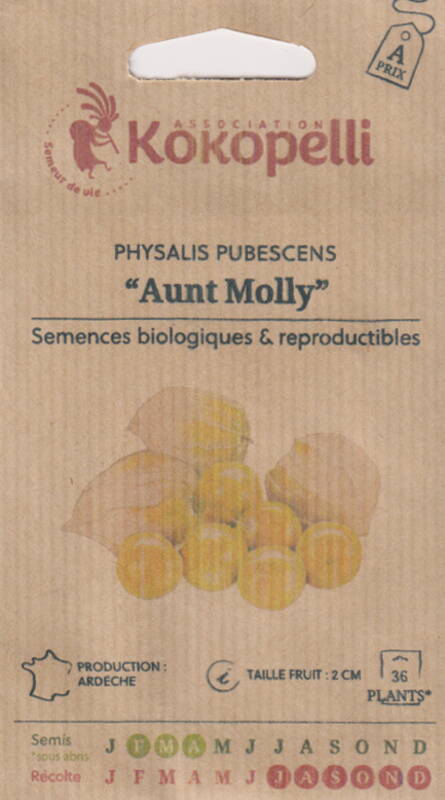
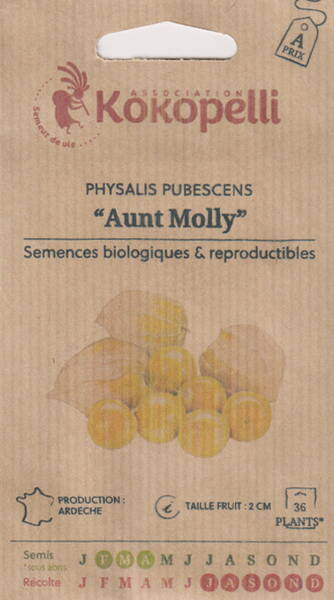
Groundcherry "Aunt Molly" (Strawberry Tomato) - Physalis pubescens.
A very old and popular heirloom variety of groundcherry, producing an abundant harvest of small, firm berries with a complex sweet flavor reminiscent of tangerines, wild strawberries, and pineapples. If you leave the ripe berries inside their natural papery husks and store them in a dry, well-ventilated place, they will keep perfectly for several weeks.
This is an incredibly tasty and highly productive variety. Harvesting of the first berries begins about three months (90-100 days) after emergence.
Maturation speed: mid-season.
Plant height: 20–40 cm.
Bush diameter: 90–100 cm (plants are highly branched, becoming very spreading and trailing by the end of the season).
Fruit color: yellow-orange.
Fruit size: about 2 cm (weight up to 9.0 g).
Flesh texture: firm, juicy.
Yield: up to 3 kg/m2.
The berries possess a unique dessert flavor with subtle hints of grape. They make absolutely delicious sweet preserves, jams, and candied fruits (the jam looks very much like yellow sweet cherry jam).
A very old and popular heirloom variety of groundcherry, producing an abundant harvest of small, firm berries with a complex sweet flavor reminiscent of tangerines, wild strawberries, and pineapples. If you leave the ripe berries inside their natural papery husks and store them in a dry, well-ventilated place, they will keep perfectly for several weeks.
This is an incredibly tasty and highly productive variety. Harvesting of the first berries begins about three months (90-100 days) after emergence.
Maturation speed: mid-season.
Plant height: 20–40 cm.
Bush diameter: 90–100 cm (plants are highly branched, becoming very spreading and trailing by the end of the season).
Fruit color: yellow-orange.
Fruit size: about 2 cm (weight up to 9.0 g).
Flesh texture: firm, juicy.
Yield: up to 3 kg/m2.
The berries possess a unique dessert flavor with subtle hints of grape. They make absolutely delicious sweet preserves, jams, and candied fruits (the jam looks very much like yellow sweet cherry jam).
Historical background: This heirloom variety is a direct relative (or synonym) of the famous «Goldie» line, which was distributed by the Walter Schell seed company from Pennsylvania back in 1920. Botanist William Darlington described this plant type in 1837, noting that it was introduced from the Caribbean region in the 17th century.
Cultivation agrotechnics.
Physalis is a light- and heat-loving plant that absolutely cannot tolerate water stagnation in the soil.
It is not recommended to plant it after other nightshade crops (tomatoes, peppers, eggplants, potatoes), as this will significantly reduce productivity and increase the risk of disease.
In temperate climates, physalis is grown through seedlings (the age of seedlings before planting out is about 35 days).
Sowing is done in the spring: fill a container with light, nutritious soil, moisten it, and sow the seeds shallowly (to a depth of 0.5 cm). Cover the container with clear film or glass and place it in a warm (+20...+25°C), bright place.
After emergence, remove the cover. Prick out the seedlings into individual cups at the stage of 1-2 true leaves. When planting the hardened seedlings in the ground, they can be slightly buried up to the first true leaf. The bushes spread widely, so they may require light support or soil mulching under the branches.
Water the plants moderately, only as the soil dries out. Important rule: groundcherries do not require pruning or pinching of side shoots! The harvest is formed precisely in the forks of the numerous lateral branches.
From the beginning of August, abundant watering should be completely stopped – this will halt the growth of green mass and accelerate the ripening of the set fruits. If the papery husks («lanterns») have turned yellow and dried up, it means the berries are ripe and ready to be harvested.
* Interesting facts about Physalis species:
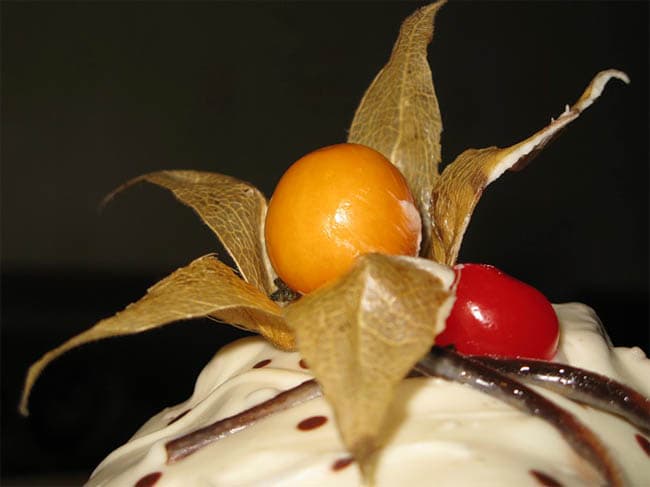
Downy Groundcherry or Husk Tomato (Physalis pubescens, to which the Aunt Molly variety belongs) is an early-maturing and relatively cold-resistant species. It ripens perfectly every year even in the open ground, although in a plastic greenhouse the yield will expectedly be higher.
There is also another popular sweet species — Peruvian Groundcherry (Cape Gooseberry) (Physalis peruviana). This includes tall and late-ripening varieties. The berries of P. peruviana are not as cloyingly sweet as those of P. pubescens, but they possess a very bright fruity taste and a rich aroma, and in their balance of sugars and acids, they are close to garden strawberries.
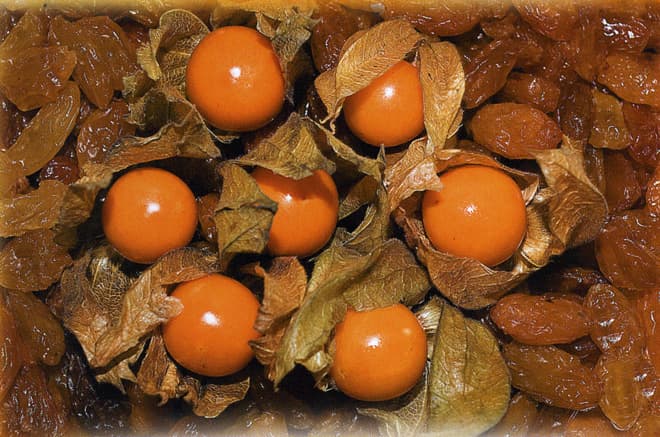
If the berries of either species are dried in an open oven at a temperature of +40...+50°C (they may rot in the open air due to their dense skin), you will get an excellent dried fruit resembling raisins or small dried apricots.
Health benefits.
Physalis is not only a delicious treat but also a valuable dietary plant. Even its leaves and roots have medicinal properties, but the fruits are especially beneficial. They contain essential organic acids, tannins, antioxidants, and vitamins. The pectins, which physalis is very rich in, help in the natural elimination of heavy metals and toxins from the body.
Physalis pubescens L.